
You know your business. You know the work, the customers and the problems you solve.
But when someone visits your website for the first time, they don’t have that knowledge.
They see a headline, a few paragraphs, perhaps a list of services and a contact button. From that, they’re expected to decide whether your business is worth contacting.
That’s a lot to ask of a website that hasn’t been properly reconsidered in years.
For a small service business, an outdated website isn’t necessarily one that looks old. It may look perfectly modern and still leave visitors unsure about what the company offers, who it’s for or what happens after they get in touch.
The question isn’t simply whether you need a new website. It’s whether your current one is helping the right customers recognise that your business can solve their problem.
Here are five signs that something needs to change — and how to decide whether a focused new website would be the better investment.
1. Your website describes the business, but not the customer’s situation
Many service websites begin with the company itself.
“We are a trusted provider of comprehensive solutions, committed to quality, reliability and customer satisfaction.”
There’s nothing particularly unusual about that sentence. That’s part of the problem.
It could describe a cleaning company, an IT provider, a maintenance contractor or almost any other service business.
Now imagine a small company maintaining commercial properties in Helsinki.
Instead of opening with general promises, its homepage might say:
“Routine maintenance for small commercial properties in Helsinki. Tell us what needs attention, and we’ll explain the next step before any work begins.”
This is a fictional example, but the difference is practical.
A potential customer can identify the service, the type of property and how to begin.
That’s what a useful first impression should do.
It doesn’t need to tell the visitor everything. It needs to give them enough information to recognise whether they’ve come to the right place.
If your website could belong to almost any company, it probably isn’t explaining your particular service clearly enough.
2. Your business has changed, but the website hasn’t kept up
Perhaps you started by offering several unrelated services. Over time, one became the main source of business.
Or perhaps your customers have changed. You now work mainly with small companies, property managers or a particular type of client.
Yet the website still gives every old service equal attention.
For a visitor, that can create an odd experience.
The business may be good at something specific, but the website presents it as a general provider willing to take on almost anything.
That makes it harder to see what the company is particularly suited to do.
You don’t necessarily need to remove every secondary service. But the main offer should be easy to find and understand.
A useful question is:
If a potential customer only remembers one thing about your website, what should it be?
If you can’t answer that without listing five different services, the page may need a clearer direction.
Sometimes this can be fixed with better copy and a more deliberate section order.
But when the entire website has grown around an old version of the business, starting with a focused new page may be more practical than continuing to patch it.
3. Customers have to contact you to understand the basics
Think about the questions you repeatedly answer in emails or initial conversations.
What does the service include?
Do you work with companies like ours?
Which areas do you cover?
How is the price determined?
What happens after we send a request?
These questions are part of how customers evaluate a service.
If the website doesn’t address them, visitors have to do extra work before deciding whether to make contact.
Some will ask. Others may look for a provider that explains things more clearly.
This doesn’t mean publishing every detail or turning your homepage into a lengthy instruction manual.
It means giving people enough information to make a sensible decision.
For example, a bookkeeping service may need to explain the type of businesses it works with, what its monthly service covers and how onboarding begins.
A property maintenance company may need to distinguish routine work from urgent repairs.
A recruitment specialist may need to explain which roles it handles and how it assesses the initial brief.
The questions are different, but the principle is the same.
A strong service website should reduce unnecessary uncertainty before the first conversation, not rely on that conversation to explain everything.
4. The next step isn’t obvious
Imagine a visitor has read the page and decided your service might be suitable.
What should they do now?
Some websites offer several competing options: book a call, request a quote, subscribe, download a guide or fill in a detailed form.
Others give almost no guidance beyond a generic Contact button.
Neither approach is automatically wrong. The right next step depends on what the customer knows and what the business needs to assess.
But for many small service companies, a simple written enquiry is enough to begin.
The visitor describes the situation. The business reviews whether it’s a suitable fit. Both sides decide whether to continue.
That’s straightforward, provided the website makes it clear.
If someone isn’t ready for a quotation, demanding a full project specification may be premature.
If they already know exactly what they need, forcing them into an introductory sales call may feel unnecessary.
The contact process should match the decision the visitor is ready to make.
A clearer website doesn’t just make the button easier to find. It explains what the customer can expect after using it.
5. Your website has become difficult to improve
A website can accumulate problems slowly.
A new service gets squeezed into an old layout. Another section is added to explain something customers keep asking about. The homepage gets longer, but not necessarily clearer.
Eventually, the problem is no longer a single weak paragraph.
The whole page has lost its direction.
This is where a new website can make commercial sense.
Rather than trying to preserve every existing section, you can organise the page around the decisions a potential customer needs to make:
- What does this business do?
- Is the service relevant to my situation?
- What is included, and what should I expect?
- Why should I consider this provider?
- What is the next step?
Those questions give the website a purpose.
They also help decide what belongs on the page and what can be left out.
A smaller, more focused website can be more useful than a larger one that makes every service compete for attention.
Of course, rebuilding isn’t automatically the right answer. If your current website works well and simply needs clearer content, replacing it may be unnecessary.
But if the existing design and structure continually get in the way of explaining the business, a fresh start deserves serious consideration.
What should a new service business website actually improve?
A new design on its own is not enough.
You can replace the fonts, colours, photographs and animations while keeping exactly the same confusing message.
The result may look more expensive without being any easier to understand.
For a small service business, I would prioritise three things.
One clear primary offer
The visitor should quickly recognise the main service and the type of customer it’s intended for.
This doesn’t mean pretending the company only does one thing. It means giving the page a clear starting point.
Enough information to make a decision
The website should address the practical questions that determine whether a potential customer wants to get in touch.
Real examples, accurate service details and a clear explanation of how the work begins can be more useful than another paragraph about excellence and customer satisfaction.
Where customer references, or other evidence are available, use them accurately. Don’t invent testimonials or claim results you cannot demonstrate.
A straightforward route to contact
Once someone understands the service, they shouldn’t have to work out how to enquire.
Make the next step visible, explain what information is needed and avoid unnecessary obstacles.
These three priorities are closely connected.
If the offer is unclear, the contact button cannot fix it.
If the service is explained well but the enquiry process is awkward, visitors may still hesitate.
And if nobody relevant is finding the website, clearer design alone won’t solve the visibility problem.
That last point matters. A new website is not a substitute for search visibility, referrals or other ways of reaching potential customers.
Could a short AI Presenter help?
Sometimes one part of a service is easier to explain when someone talks the visitor through it.
It might be the first inspection, the quotation process, what happens after a request or how a particular service works.
A short AI Presenter video can support that explanation.
But it should have a specific job.
It shouldn’t repeat the entire homepage, make exaggerated promises or hide important information behind a Play button.
The visitor must still be able to understand the offer without watching the video.
And AI-generated presenters should be identified as such. They aren’t real customer testimonials or substitutes for the people doing the work.
Used carefully, a Presenter can add another way to understand the service. Used without a clear purpose, it’s just another element competing for attention.
That’s why the website’s message and structure come first.
What this looks like in practice
This is the thinking behind SvereSystems.
I build focused websites for small service businesses that need a clearer way to explain what they offer, who they help and what happens next.
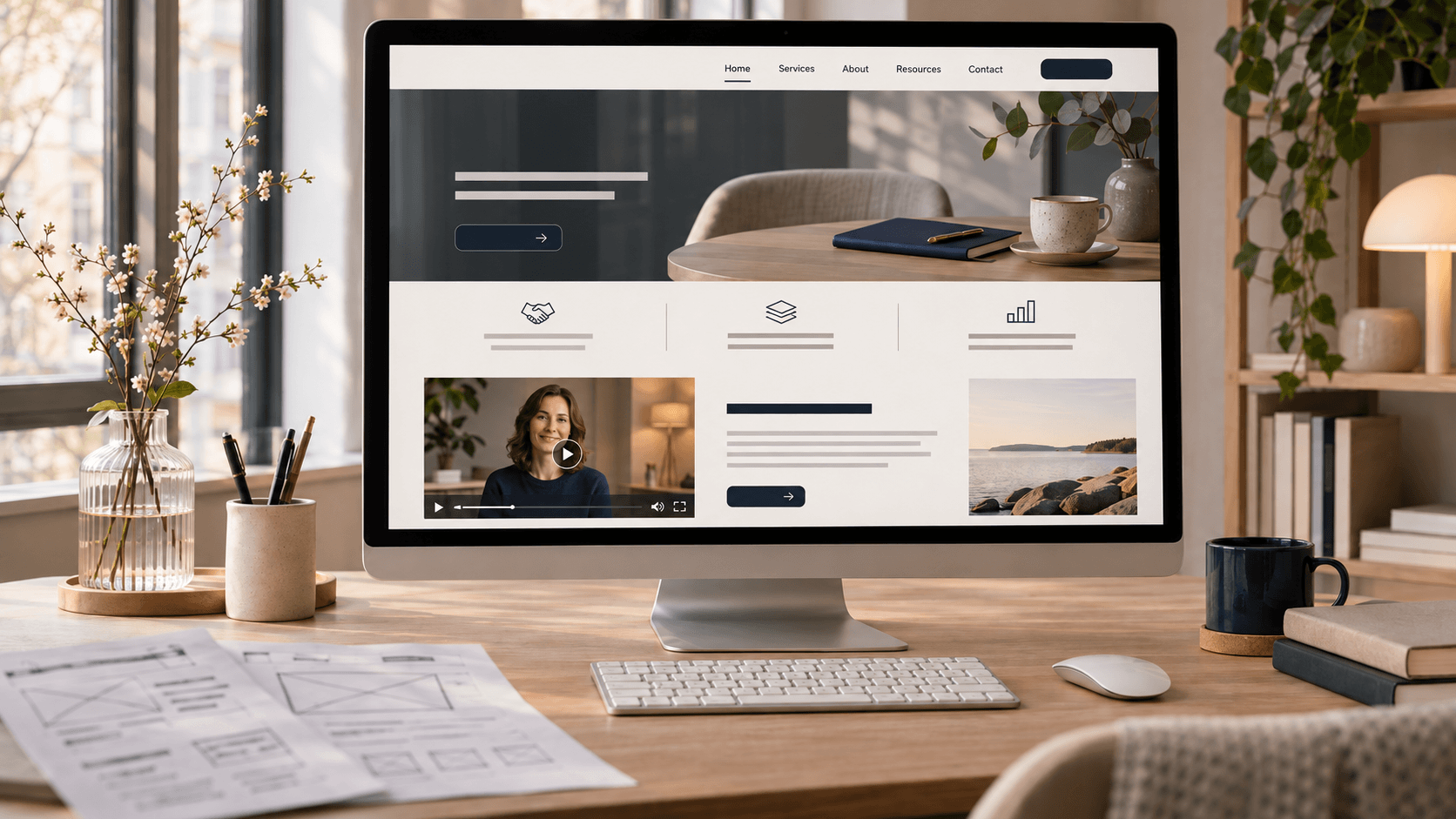
The main package combines a new responsive HTML website with a short AI Presenter explaining one useful aspect of the service or customer process.
The website can also be ordered without the Presenter.
The work follows a defined structure rather than open-ended custom development. It includes agreed service wording, a clear page layout, a contact route, a private preview and one consolidated round of minor changes within the agreed scope.
You can see the approach in the SvereSystems website examples.
These are working demonstrations built around fictional businesses, not commissioned client projects or evidence of improved conversion rates.
For a business with an existing website that’s still suitable, limited content and structure guidance may be another option. That route doesn’t include making changes inside the client’s website platform.
The standard new-website package also doesn’t include ongoing SEO campaigns, complex software integrations or unlimited custom development. Website publication is handled by the client or their provider unless a separate installation service is agreed.
Those boundaries are deliberate. The service is intended for businesses that need a focused website, not a large technical project.
Before you invest in another website
Take one final look at your current homepage.
Imagine a potential customer arriving with a particular problem, little time, and no prior knowledge of your business.
Can they recognise that you offer the service they need?
Can they understand whether it is suitable for them?
And can they see what to do next?
If the answers aren’t clear, you’ve found something worth addressing.
That may mean improving the existing page. Or it may be time to build one around the business you run today, rather than the business you had when the old website was created.
The investment should make your service easier to understand and easier to enquire about — not simply give your company a newer-looking website.
See whether SvereSystems is the right fit.
If you run a small service business and are considering a more focused website, review the SvereSystems Website + AI Presenter packages, current pricing, and delivery details.
You can also explore the working website demonstrations before deciding.
If the approach suits your business, send a short, non-binding project request through the service page. Include your current website address if you have one, along with a few words about what your business offers and what you’d like to improve.
I’ll review the request and reply in writing. There’s no introductory sales call or payment required just to enquire.
By Sven | SvereSystems Insights